

News
Industries
Projects
The Myth of “Baseload vs. Green”: How Intelligent Automation Unifies Our Grid
Our Grid
1. The False Choice in Energy
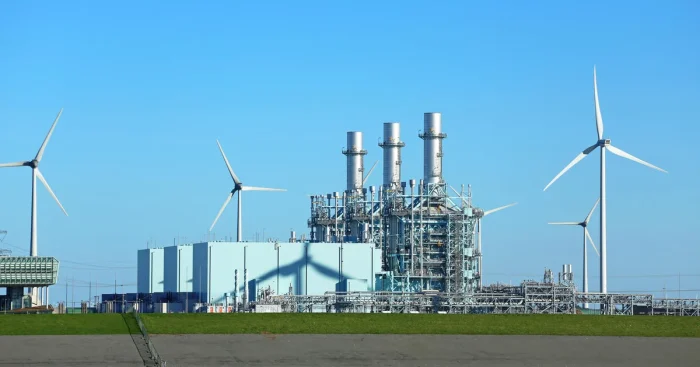
For decades, a false choice has dominated the energy industry. On one side, we have traditional baseload power, like the combined-cycle plant pictured—reliable, dispatchable, but carbon-intensive. On the other, we have renewables like the wind turbines—green, clean, but intermittent and unpredictable. The conventional wisdom was that you had to choose: reliability or sustainability.
This view is now obsolete. The future of energy is not "either/or." It is "both/and." The challenge is no longer about choosing a source; it's about integrating them.
The problem is one of intelligence. How does a massive, 500 MW steam turbine, designed for slow, steady operation, react when a cloud bank suddenly causes a 200 MW drop from a nearby solar farm? How does the grid stay stable when the wind stops blowing? The answer isn't to build more baseload plants; the answer is to make our existing plants smarter.
2. Driving Energy: The "Smart" vs. "Dumb" Power Plant
A traditional power plant is a "dumb" asset. It is a brute-force machine designed to run at a steady, optimal speed. Its pumps and fans, which can consume tens of megawatts of power themselves, are often controlled by mechanical valves or run at a single, fixed speed. When the grid needs more power, this "dumb" plant is slow to respond, taking hours to ramp up. It simply cannot move fast enough to compensate for the rapid fluctuations of renewable energy.
This is where our mission—to "drive energy" and "enli-ven intelligence"—becomes a tangible, real-world solution. We accelerate the digital transformation of these legacy assets.
We integrate a high-speed automation "brain," like a redundant Siemens S7-1500 system, that can think in milliseconds. Then, we connect that brain to the plant's "muscles": its largest motors. By installing Variable Frequency Drives (VFDs) on the massive boiler feedwater pumps, condensate pumps, and cooling tower fans, we give the plant something it never had before: instantaneous, precise control.
3. Integrating Intelligence: The "Grid as a Community"
With this new intelligence, the power plant is no longer a slow, isolated silo. It becomes an agile, active participant in a "unified community" of assets.
When our central controller sees the wind turbine output begin to drop, it doesn't wait for a failure. It acts. It instantly commands the VFDs on the boiler feedwater pumps to increase their speed, raising the steam drum level. Simultaneously, it ramps up the VFD-controlled fans to prepare for the new load.
Because of this integrated intelligence, the plant can now ramp its output from 40% to 80% in minutes instead of hours. The VFDs not only provide this critical speed, but they do so with immense efficiency, saving massive amounts of energy (and carbon) in the process.
This is the solution. The "green" energy (wind) is now stable and reliable because the "conventional" energy (gas) has been made "smart." We have used digital technology to solve the core challenge of the energy transition, measurably reducing the carbon footprint of the entire grid by enabling more renewables to be safely installed. This is how we build a better future, together.