

News
Industries
Projects
The Sustainable Plant Isn’t Just “Green”—It’s “Smart”
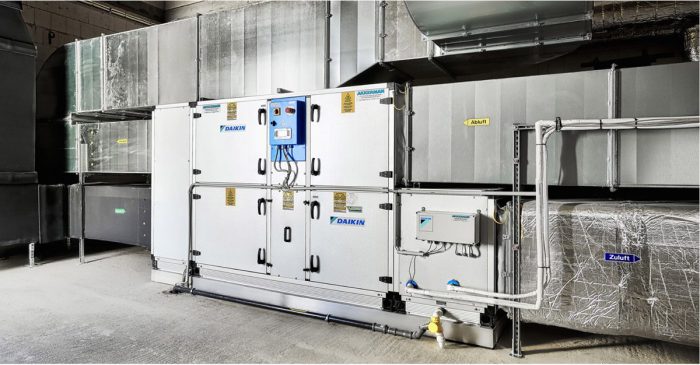
When many industrial operators look at a system like the one in the first image—a complex array of filters, ducts, and fans—they see a "green" asset. They see a single piece of equipment designed to do one job: remove pollutants from the air. This, however, is an outdated, 20th-century view of sustainability.
True sustainability in the modern industrial era is not achieved by simply installing "green hardware." It is achieved by making that hardware intelligent. The most significant environmental and financial gains are not found in the filter media itself, but in the process control and automation that drives the entire system.
This is the core of what we do. An old-school fume or dust extraction system might use a 1-megawatt fan running at 100% speed, 24/7, with a mechanical damper to control airflow. This is the equivalent of driving your car with the accelerator floored and using the brake to control your speed—it's incredibly wasteful and puts massive mechanical stress on the equipment.
The sustainable, "smart" approach—our daily reality—is to "integrate intelligence" into the process. We install a Variable Frequency Drive (VFD) on that same fan, networking it via Profinet to a central S7-1500 PLC. This "enlivens" the system. Now, sensors in the ductwork can tell the PLC exactly how much suction is needed based on the process (e.g., furnace charging vs. tapping). The PLC, in turn, tells the VFD to run the fan at the precise speed required—say, 65% capacity.
The results are transformative. By "driving energy" intelligently, you've just cut the fan's power consumption by nearly 75%. The carbon footprint of that system plummets. The mechanical stress disappears, extending the motor's life. The system is quieter, more reliable, and far cheaper to run.
This is the real face of digital transformation in sustainable industry. It’s not about one magic-bullet component. It’s about the holistic integration of edge technologies (like VFDs) with powerful automation (PLCs) and transparent monitoring (SCADA).
This is our philosophy of "human interconnectedness," applied to machines. When your systems stop being isolated silos and start collaborating as a unified community, the entire plant becomes more than the sum of its parts. It becomes a single, efficient, and truly sustainable operation, building real value while measurably lowering its impact on global warming.